

🔁 I Cut TDD From My Agent Workflow.
Then I Put It Back.
By Rob Park · Nov 27, 2026
I've built software with an ATDD/TDD double loop for well over a decade. The outer loop is an acceptance test: a scenario, written in plain language and automated, that describes what the system should do from the outside. The inner loop is TDD: write one failing unit test, make it pass, pause on green to consider the design, repeat. The acceptance test sets the goal. The unit tests drive the design on the way there.
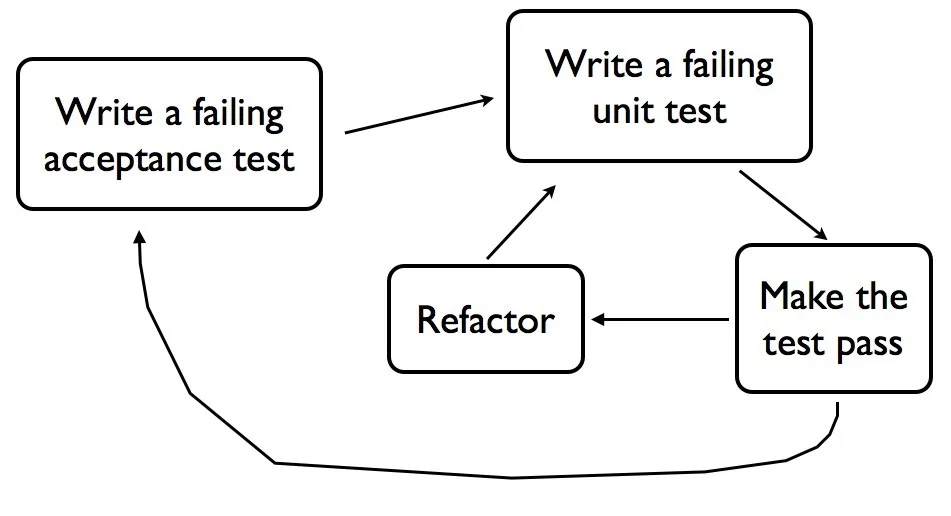
Image: Emily Bache, Outside-In Development with Double Loop TDD
When I started coding with agents, I dropped the inner loop.
What I did instead
Early on, getting an agent to do TDD was frustrating. It didn't understand why you write the test first, watch it fail, and check that it fails the way you expect. It didn't understand the deliberate pause after green to think about the design. It wanted to write a large chunk of implementation and then cover it with unit tests afterwards.
So I let the agent do the inner loop its own way and held firm on the outer one. My /prepare-story skill sets up every implementation plan to start from a failing acceptance test, written in Gherkin, that I can discuss and verify with the agent before it drives the implementation. To be clear, this isn't spec-driven development, where a prose spec is handed to an agent to implement. This specification is executable and deterministic, and it runs in the pipeline.
It worked well across several projects. Commits were bigger than when I committed on every passing unit test, but still much smaller than most PRs I've reviewed from colleagues. Refactoring happened at a coarser grain, but when it was needed, it was usually obvious.
I wasn't alone in landing there. Bryan Finster and Birgitta Böckeler have each argued that when an agent is writing the code, the inner TDD loop may not pay for itself.
My own reasoning ran the same way. Most of what I get from TDD as a programmer is learning and better-reasoned design. Agents don't learn that way. And if the acceptance tests are fine-grained enough, I can still make small, low-risk changes in production.
That matched my experience. For a while.
The signals
I'd added more rigor around the shape of the code to make up for the missing inner loop. Does the overall structure make sense? Is coverage above 90%? Are files under 200 lines? Those checks kept passing, but a few things started to bother me:
- I couldn't predict where the next change would land. Over time, I lost my sense of which parts of the codebase a new story would touch.
- I didn't know whether the unit tests mattered. Coverage was high, but I couldn't say which tests were important and which were just there.
- I trusted the design less. It wasn't obviously wrong. I just didn't have the confidence I'd always had when building with TDD.
None of these show up on a dashboard, but they can be early warning signs that a codebase is getting expensive to change.
The experiment
Meanwhile the conversation kept going, with other takes on how TDD can work with agents, like Emily Bache's. Later, a webinar with practitioners tackling the same problem showed how many different ways people are trying it. None of them looked quite like what I had in mind, which kept me much closer to every cycle. So instead of asking the agent to follow TDD on its own, I tried doing TDD with it. The agent still writes all the code, but every cycle goes through me:
- Agree on the next test. The agent proposes what the next test should be and why. We settle it before any code is written.
- Write it and watch it fail. The agent writes the test. I often run it myself, and we check the failure against our current hypothesis. Is it failing for the reason we expect?
- Make it pass. The agent gets the test to green and suggests next steps.
- Commit to main. Usually right here, on every passing test.
- Reflect. This part is mine: deciding, with the agent's suggestions in mind, whether anything needs refactoring or whether anything confuses either of us. We clear that up before the next test.
It's slower per story than ATDD alone, and it's very much human-in-the-loop. It has also been one of the more satisfying ways I've worked with an agent.
What changed
The biggest difference is understanding. The case for dropping the inner loop was that agents don't learn from it, and that's true. But I still do. The inner loop was never really for whoever types the code. It's for whoever has to understand the design and own it, and that's still me.
I know how this service is built, why it's shaped the way it is, and where the next change will probably land. The three signals that bothered me have faded, and my confidence in the design is back to where it was before agents.
The delivery side surprised me. Committing to main on every passing test means much smaller increments than ATDD-only gave me. Each change is smaller, easier to reason about, and gets into production and starts teaching us something sooner. Running the pipeline that often also means paying much more attention to it, and that attention has built more confidence in the pipeline itself. It even nudged me into making one of my pipelines a little faster.
When I use which
This isn't a verdict that TDD always wins. Kent Beck's talk at Rise8 is what got me thinking about choosing the style to fit the project rather than picking one for everything. Projects warrant different levels of focus, and I now choose deliberately:
| Cost of getting it wrong | Approach |
|---|---|
| Low, like a simple website | Neither. Let the agent build it. |
| Moderate, like an internal tool | ATDD only. The outer loop is enough. |
| High, like services for a financial application | Agentic TDD. |
Under real time pressure, I might fall back to ATDD-only even on a project I care about. But I'd make that choice knowingly, because I've seen what it costs.
The bigger lesson isn't about TDD. I started from a method I knew, changed it, watched what happened, and adjusted. That was more useful than deciding up front, either way, whether agents make the old practices obsolete.